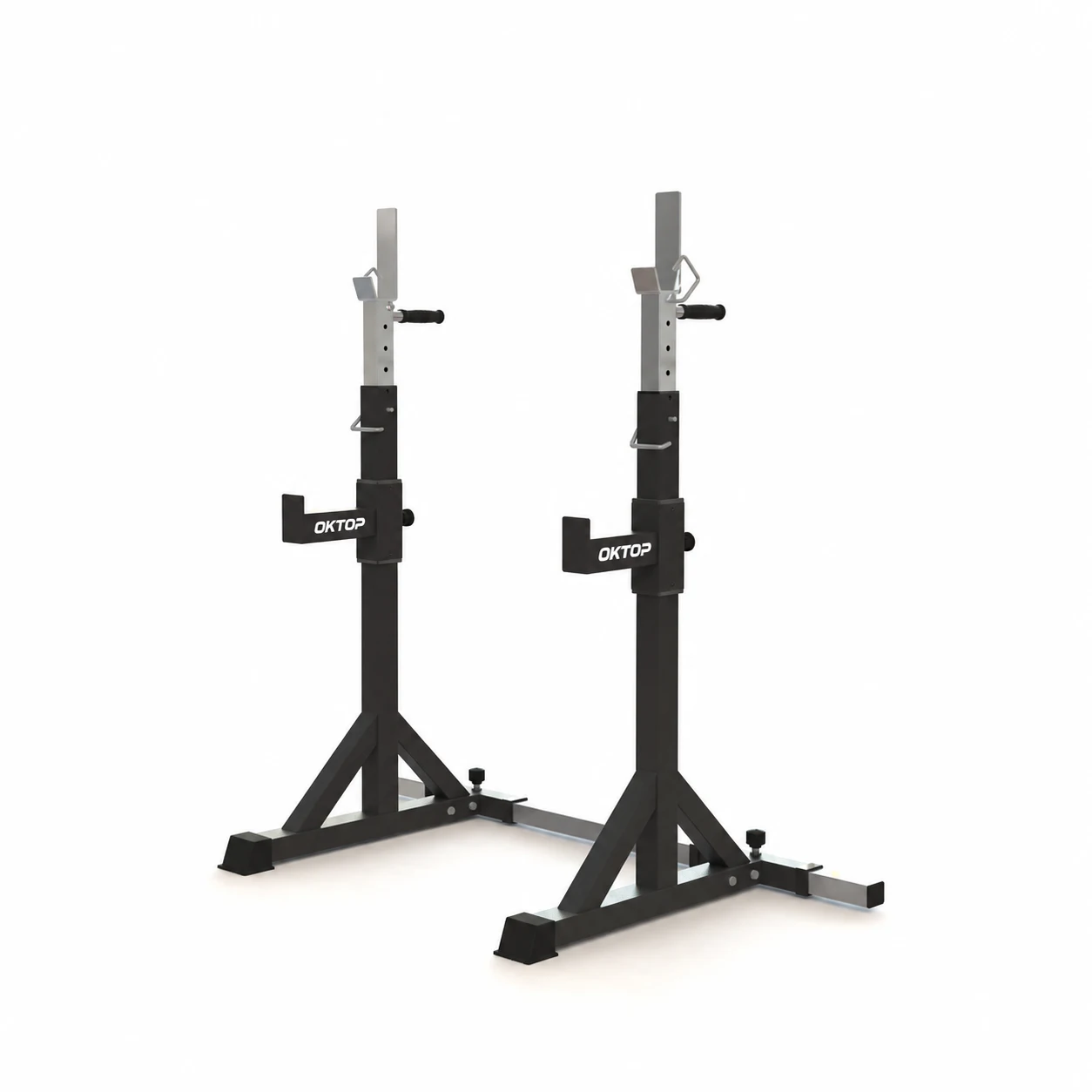
Five stand names are five catalogue lines
A buyer who asks for “squat stands” can still receive the wrong item. The racks and trainers category lists five stand references as separate codes for commercial racks and trainers programmes and project-based sourcing. The shared wording does not state upright height, adjustment range, footprint, base style, safety arms, plate storage, floor fixing or a user limit. Choose one code, or more than one as separate lines, before a quotation is requested.
| Code | Catalogue name | What the listing states |
|---|---|---|
| OT5107 | Heavy-Duty Adjustable Squat Stands | Separate stand code, not a second label for OT5121 |
| OT5121 | Adjustable Squat Stands | Separate adjustable-stand code, not a duplicate of OT5107 |
| OT5136 | Heavy-Duty Squat Stand | Separate stand code. “Heavy-duty” is part of the name, not a published rating |
| OT5137 | Independent Squat Stands | Separate stand code. “Independent” is part of the name, not a layout drawing |
| OT5139 | Olympic Squat Stand | Separate stand code. Olympic appears only inside this catalogue name |
Each product page confirms the name and category, and asks for any detail the page does not state. A word in one name, such as adjustable, heavy-duty, independent or Olympic, is not a feature of the other four codes.
A stand is not a power rack or a squat rack
OT5074 Squat Rack with Safety Bars is a nearby listing, described as a commercial squat rack supplied with safety bars. That is a rack reference, not one of the five stand codes. OT3102 Power Rack is a further reference in the same category. The functional trainer versus power rack guide compares those two station types. It does not choose among the five stand codes. A smith machine, a half rack or a functional trainer belongs on its own brief.
If the project needs a squat rack or a power rack as well as a stand, specify each code and each quantity. If only stands are needed, mark the rack codes as not selected.
Build the station file around the selected code
Plates, bars, benches and safety arms are not included by the product name. Configuration, quantity, packing, application and destination market have to be confirmed for each stand code. For the comparison file, record:
- which codes are selected, and which of the five were reviewed and rejected;
- the catalogue name copied beside each code, so an adjustable pair cannot be swapped with a single stand;
- any rack code that was reviewed and rejected, including OT5074 or OT3102;
- the commercial setting, such as a lifting platform, a coached strength area, a member floor or a distributor range;
- the approximate quantity of each selected code, and whether the stands are for one site or several;
- the destination market and any receiving, ceiling or storage constraint already known; and
- the upright, base, safety-arm, bench and documentation questions that still need a written answer for each code.
A bar or a bench chosen for one stand is not evidence that another stand uses the same interface. Compatibility stays open until the supplier confirms it for the quoted item. This guide does not assign a loading method or a user limit.
Ask each quotation to say which stand it covers
Before offers are compared, ask the supplier which scope is offered for each code. A pair of stands, a single stand, and a stand quoted with safety arms are different supply scopes.
Ask for the current description, configuration, instructions and packing information. If a document is required, name the code it applies to. Do not carry a statement about OT5139 across to OT5107. Adjustment range, base and the space around the station have to be confirmed in writing.
Lock the chosen name, then receive by code
Where a sample or a document review is appropriate, compare the reference and the supplied components with the written brief for that code. Approval of one stand is not approval of the other four, and it is not approval of OT5074 or OT3102.
Before shipment, agree a check for product identity, quantity, labels and packing, code by code. The check does not replace a local review of floor or user clearance. Price each confirmed reference on its own line, and separate stands from bars, plates, benches, packing and shipping terms. Adding another stand code, or switching to OT5074, needs a reissued confirmation. A carton marked only “squat stand” is not enough when more than one code was ordered.
FAQ
Which squat-stand references does this comparison use?
This guide compares OT5107, OT5121, OT5136, OT5137 and OT5139. They are separate catalogue items. OT5074 and OT3102 are rack references and should be quoted only when the buyer has selected them. Confirm each chosen product against the live enquiry before ordering.
Does a shared category description mean the five stands have the same build?
No. The listings place the stands in commercial racks and trainers programmes and project-based sourcing. Upright height, adjustment, base, safety arms, footprint and included components are not stated. Confirm each code in writing. A word in one product name is not a specification for the others.
What should a squat-stand comparison enquiry include?
Include each selected code and catalogue name, the commercial setting, the approximate quantity of each code, the destination market, and the upright, safety-arm, bench or documentation points that still need written confirmation. List racks and other stations on separate lines.
Choose the stand code before the price conversation
A usable comparison names the selected stand codes and lists the points that are still open on each line.
Review OT5107 Heavy-Duty Adjustable Squat Stands, review OT5139 Olympic Squat Stand, browse racks and functional trainers, read the functional trainer and power rack comparison, or send your squat-stand requirements.