Introduction
An air bike, rowing machine and ski machine can all sit in a high-intensity conditioning zone, but they do not solve the same programming or project problem. Buyers often compare them as if one must replace the others. In a commercial gym, the more useful decision is usually which mix matches the facility’s members, class format, floor plan and service capability.
This guide compares the three machines through a commercial-buying lens. It does not rank one machine as universally “best.” Each can be valuable when selected for the right application and supported by a clear layout, coaching plan and supplier specification.
Quick answer: when each machine is a strong fit
- Choose an air bike when the facility needs an intuitive, high-output station with a seated position and a simple transition from coached intervals to open-gym use.
- Choose a rowing machine when the programme benefits from a seated, full-body pulling pattern and a long, repeatable stroke cycle.
- Choose a ski machine when a standing pull pattern, vertical footprint and upper-body-plus-trunk involvement suit the programming and available space.
- Choose a mixed cardio line when group training, hybrid conditioning or broad member usage requires varied movement patterns and less station congestion.
These are starting points, not substitutes for final product reviews. Confirm the chosen machine’s footprint, required clearance, resistance system, monitor options, power requirements if any, maintenance access and exact assembled dimensions before procurement.
Compare the movement and member experience
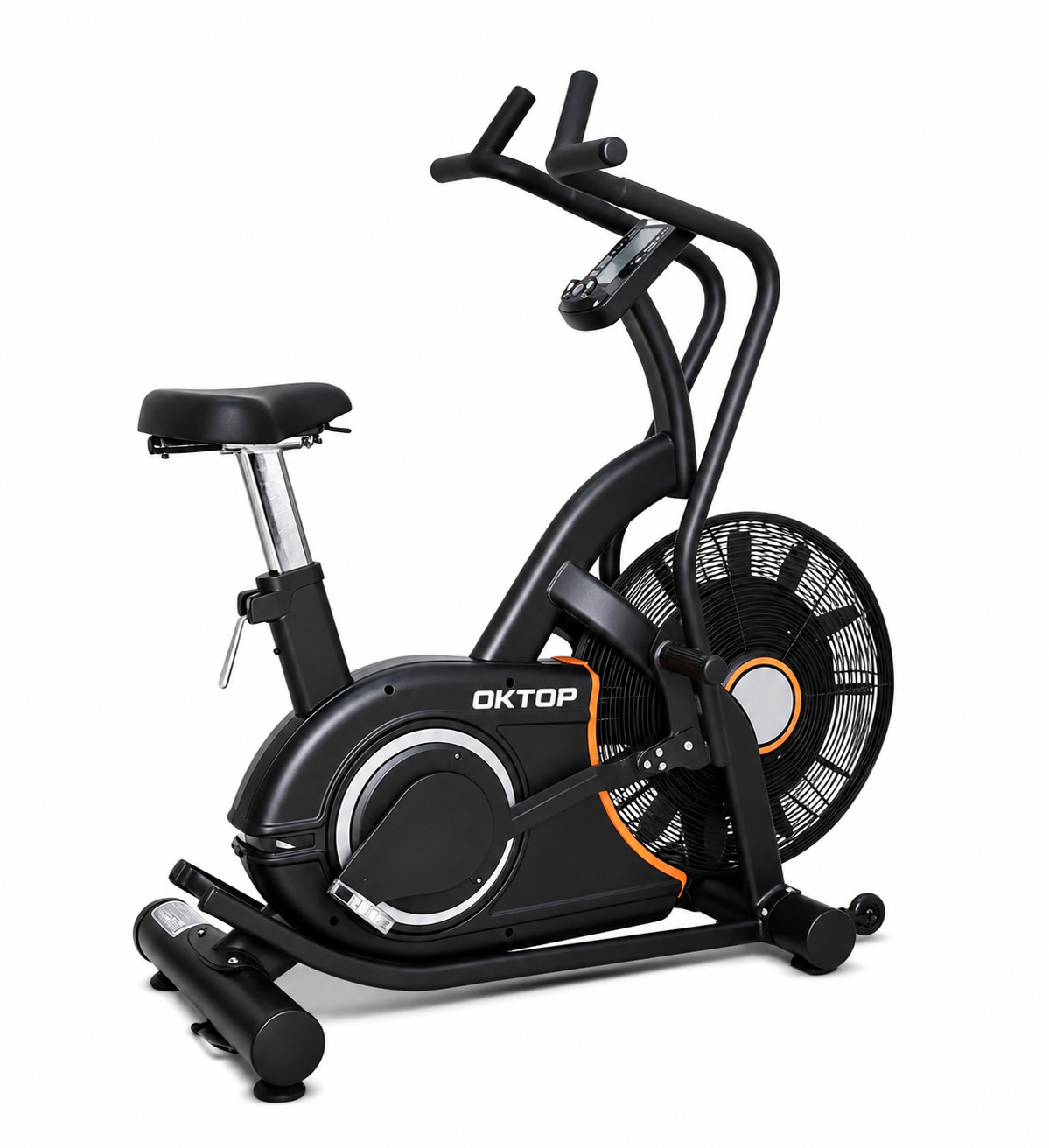
Air bike: seated, full-body intervals
An air bike combines pedalling with moving handles. It is familiar to many users because the basic seated position resembles cycling, while the handles add an upper-body contribution. In a coached class, that makes it relatively quick to explain. For a facility with varied fitness levels, the self-paced nature of air resistance can be useful: a strong user can create more demand, while a new user can learn rhythm at a lower pace.
From a project perspective, inspect pedal and handle contact points, seat adjustment, stability, fan protection, transport wheels, display readability and the clearance needed around moving handles. Air resistance can produce noticeable sound, so placement matters in a hotel gym, small studio or adjacent treatment area. Do not promise a noise level based on a product category; assess the particular model in the intended environment.
Rowing machine: coordinated leg drive and pull
A rowing machine uses a sliding seat, foot supports and handle to create a long cyclical movement. It demands more sequencing than an air bike: legs initiate the drive, the trunk stays organised, and the handle finishes the stroke. Good technique helps the user train efficiently, so a commercial operator should plan a short onboarding cue or coach demonstration rather than assuming every member will use it well on day one.
The layout implication is clear: a rower needs a long operating footprint and a safe path at both ends. Check whether the model can be stored or separated only if that feature suits the commercial use case; a storage feature is not automatically a reason to accept a less suitable machine. Ask for rail length, overall length, user clearance, transport arrangement and how the machine is packed for delivery.
Ski machine: standing, vertical pull work
A ski machine uses a standing pulling action. It can suit conditioning circuits where coaches want users upright between stations, and it may be easier to accommodate than a rower in a shallow room because its working pattern is more vertical. It still requires proper wall or frame fixing, a suitable pull zone and enough clearance to avoid contact with nearby equipment.
Before ordering, verify the mounting system, height, wall or floor requirements, cord or handle service procedure, user range and any ceiling constraints. A product that appears compact in a photograph may have installation requirements that determine whether it works in a specific site.
Comparison table: the questions a buyer should ask
| Buying factor | Air bike | Rowing machine | Ski machine |
|---|---|---|---|
| Primary user position | Seated with moving handles | Seated sliding stroke | Standing pull |
| Programming contribution | Fast transitions and hard intervals | Repeatable full-body stroke work | Upright pulling and conditioning intervals |
| Layout consideration | Handle clearance and sound | Long operating footprint | Mounting, height and pull clearance |
| Coaching need | Usually quick to start | Technique cueing is valuable | Teach posture and pull path |
| Procurement focus | Stability, adjustments, fan protection, monitor | Rail, foot supports, handle path, transport | Fixing method, height, cord/handle system |
The table is a decision aid, not a technical specification. Product construction and accessories vary by model. Use it to frame a supplier discussion rather than to replace documentation.
Which machine is best for HIIT?
HIIT is a programming method, not a property of one machine. All three can be used in interval sessions when the work-to-rest structure, user capability and coaching are appropriate. An air bike may be convenient for rapid changes of pace; a rower can support paced effort over longer work periods; a ski machine can bring a standing pull station into a circuit. The better commercial choice is the machine that members can use consistently and that coaches can integrate without creating queues.
For a group class, consider the interval architecture. If a session needs six participants to work simultaneously, a single machine creates waiting time unless the class is deliberately designed as a relay. A mixed bank of machines can keep more users moving and give a coach options for scaling. This is often more valuable than filling the room with one product type.
How to choose for different facilities
Small functional-training studio
In a compact studio, every machine has to justify its footprint. Start with the programme: how many participants train at once, which stations are fixed, and what must remain clear for coaching? A ski machine may suit a wall-supported location, while a rower may require a longer clear run. An air bike is often straightforward to move but needs side clearance for handles. Model-level dimensions decide the final answer.
Full commercial gym
A larger gym can use these machines as a conditioning cluster near functional training, rather than spreading them randomly through the cardio floor. This supports coaching, member wayfinding and accessory storage. Provide enough spacing for users to mount, dismount and clean the equipment without crossing another station’s active area.
Performance or hybrid-race preparation area
For a performance-focused zone, variety is usually an asset. A mixed line lets coaches programme different movement patterns and manage athlete traffic. Pairing the machines with a sled lane, training ropes, wall balls and portable weights can create a complete session without requiring members to travel across the facility.
Distributor project quotation
For distribution, group the machines as a category but quote them with individual model information. Include product name, image, selected options, approximate packed and assembled data as confirmed by the supplier, accessory scope, commercial terms and any installation notes. A clear quotation avoids a common problem: the buyer assumes a console, wall fixing kit or transport accessory is included when it is not.
Practical specification checklist
Ask a supplier for the following before choosing between an air bike, rower or ski machine:
- Final product drawing and assembled dimensions.
- Recommended operating clearance and user-height considerations.
- Resistance type and whether the machine needs power.
- Monitor or console functions, if supplied, and any compatibility details.
- Construction materials, adjustment points and common wear components.
- Recommended cleaning and routine inspection instructions.
- Packing dimensions, gross weight and number of cartons.
- Assembly steps, tools and fixing requirements where applicable.
- Parts availability and order-specific after-sales terms.
This checklist gives procurement and operations teams the same information base. It is especially useful when the purchasing decision is made in one country and installation occurs in another.
Factory testing and shipment preparation
For moving cardio equipment, ask how the chosen model is checked before packing. A realistic review may include confirmation that the unit is assembled for inspection where applicable, moving components operate smoothly, the selected display powers on if included, the finish and labels match the order, and loose hardware is identified. Request media tied to the actual order rather than relying only on a sample image.
At shipment inspection, compare carton counts, model labels, colour or branding instructions and the packing list with the purchase order. For a ski machine, include the mounting or frame components in this check. For a rower, confirm rails, handles and accessory packs are accounted for. A disciplined checklist is more useful than a broad claim that an item was “fully tested.”
Common comparison mistakes
Selecting only on calories or headline intensity
Machine displays can present different calculations and user experiences vary. Select for programming, usability and site needs first.
Ignoring technique and onboarding
A rower or ski machine can be highly effective, but only when members understand the basic movement. Include introductory coaching in the launch plan.
Forgetting clearance and maintenance access
The product footprint is not the working footprint. Leave room for moving handles, rails, users, cleaning and service.
Buying a cardio line without a class flow
If machines are intended for coached intervals, decide who uses each one, when they rotate and where they reset. The layout should make that workflow obvious.
FAQ
Is an air bike better than a rowing machine for a commercial gym?
Not inherently. An air bike is often easier for a new user to start, while a rower provides a different full-body stroke pattern. The best selection depends on member profile, space, coaching and the intended sessions.
Does a ski machine require wall mounting?
Requirements depend on the model. Some units use wall mounting and others use a dedicated frame or base. Confirm the selected product’s fixing method and the site’s wall or floor condition before ordering.
Should a commercial gym buy all three machines?
Many hybrid and functional zones benefit from a mixed selection because it expands programming and helps distribute users. The appropriate quantity depends on class size, space and budget.
What is most important in a commercial cardio quotation?
Clear model-level specifications, dimensions, accessory scope, packing information, installation needs and after-sales terms are more important than a generic category description.
Conclusion
Air bikes, rowing machines and ski machines are complementary tools. A buyer who defines the user journey, room constraints and coaching model can select a commercial cardio mix with fewer surprises at installation. Start from the session, verify the final model documents, then build the quotation around the equipment and accessories actually required.
CTA: Compare a cardio package for your project
Tell us your facility type, approximate class size and available space. View OKTOP Hybrid Training Equipment or contact the team to request a product shortlist.